
Regulating Inflammation: 2 Essential Nutrients
You must have these or you won’t regulate inflammation…

Part 3 of 6
Inflammation is a primary root cause of chronic diseases like:
Heart Disease
Autoimmune Diseases
Type 2 Diabetes
IBS
Arthritis (all types)
High Cholesterol
Alzheimer’s/Dementia
And Many More Chronic Diseases
Americans spent an estimated $5.3 Trillion on healthcare in 2024.
Yes…Trillion with a “T”!
The U.S. government spent $1.9 Trillion on healthcare programs & services in 2024. Which made up 27% of the entire budget!
Spending on healthcare is THE largest line-item category of the entire United States government budget! To give you an idea, it is a little over 2X as much as the next biggest budgetary item: military defense
Whether it is the government alone or Americans as an entire country, we spend an INCREDIBLE amount on healthcare!
Here’s The Unfortunate Part About The $5.3 Trillion Spent on Healthcare
Roughly 80% of that amount is managing chronic diseases.
That’s approximately $4.24 Trillion per year spent on chronic diseases.
WOW!!
And each year, that number has grown because there are a higher percentage of people who deal with chronic diseases.
Just look at this pic below for those 65 and older.
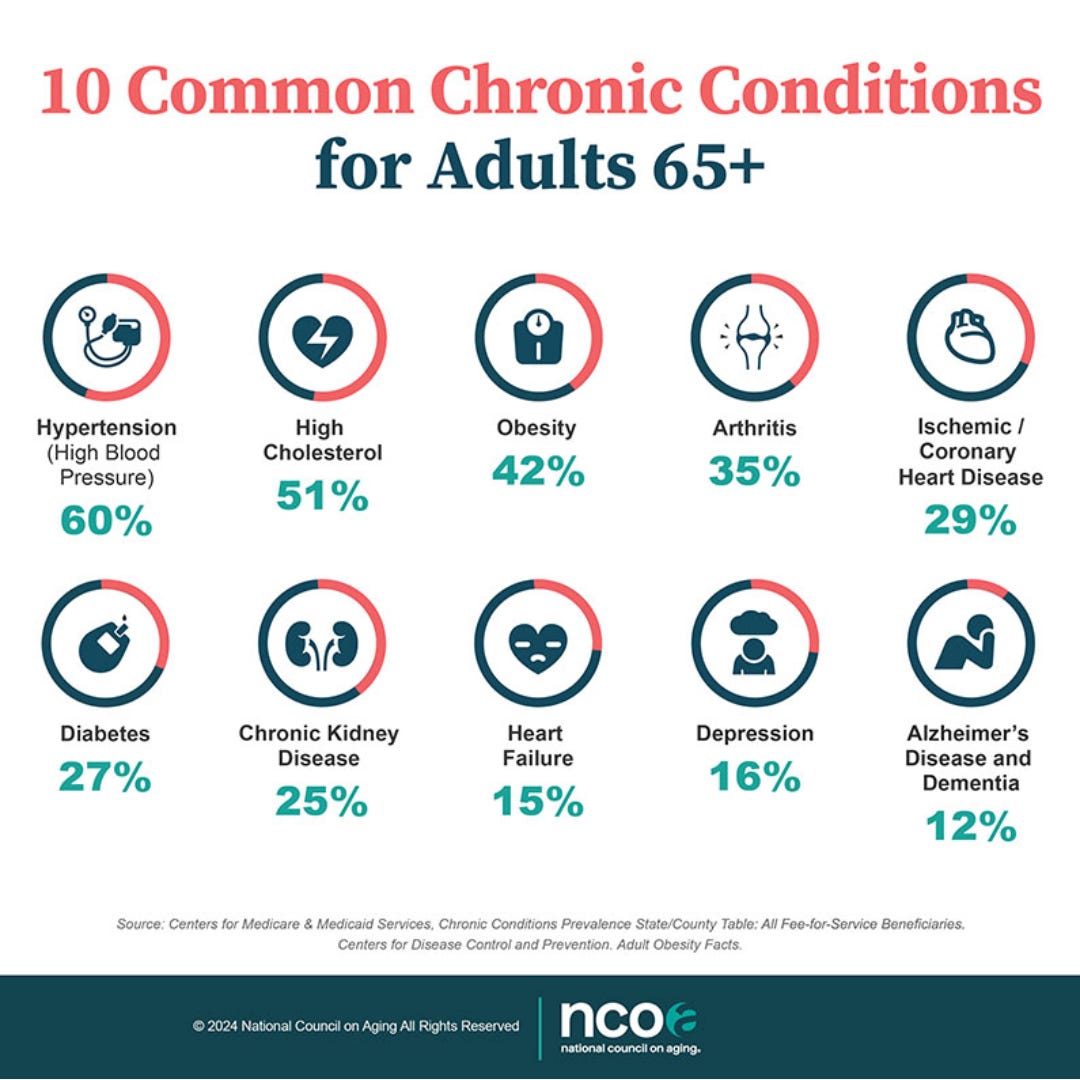
If you go back and look at previous data 5-7 years before this, you will see that these numbers have risen each and every year.
Genetics Don’t Change for 1,000s of Years. So Why Do Chronic Disease Rates Continue to Rise?
Because the root causes are not being addressed. And chronic systemic inflammation lies at the bedrock of these chronic diseases.
We are spending incredible amounts of money treating the signs/symptoms and the end stage of the diseases.
We MUST begin focusing on addressing the root causes.
Frankly, YOU must focus on addressing root causes for yourself. And when you do this, not only do signs and symptoms change, but you end up spending a lot less. And your quality of life greatly improves!
What I’ve learned (that I was not taught as a doctor):
There are 2 essential nutrients that are crucial in regulating inflammation. Unfortunately, most Americans are deficient in them, leaving them prone to the diseases of chronic inflammation that plague our country.
PART 3 of 6
My goal over this 6-part series is to provide you with the 6 most impactful interventions I’ve found in practice, that consistently produce phenomenal results for patients wanting to improve their metabolic health.
What I will cover below:
The 2 essential nutrients that are absolutely necessary to regulate inflammation (most Americans are deficient in them, as well as my patients when we first test them).
A list of foods to naturally increase them both
If supplementing, ingredients that are commonly added & manufacturing practices that are regularly done which actually PROMOTE inflammation…UGH!
If supplementing, what are therapeutic dosages for each nutrient. If you don’t get the right dosage, you’ll still be deficient and not able to regulate inflammation properly
Finally, what labs to run so you can test your bloodwork to know if you are deficient, and by what degree
Let’s dive in…
Addressing Inflammation Functionally
Like the general public, what I’ve found with my patients is their inflammation levels are not being addressed properly or functionally.
For you, we not only need to decrease what contributes to the inflammation, but also making sure you have sufficient amounts of some key nutrients that regulate inflammation.
If you don’t have these, good luck in avoiding the above-mentioned chronic diseases (and more)!
Let me explain:
Chronic inflammation and your immune response are very much connected.
There are essentially 2 types of inflammation in the research:
A pathogen associated molecular inflammation (virus, bacteria, parasite, etc.)
A tissue damage molecular inflammation
With each of the above scenarios, the response is essentially identical.
First, you get leaky blood vessels (diapedesis). This creates an inflammatory response, and you release macrophages, T cells, B cells, neutrophils, etc. They are going to address the pathogen, or they are going to clean up the damaged tissue.
I’m going to focus on the macrophages specifically.
In the first 72 hours after a pathogen or injury, they’re released as M1 macrophages.
These are pro-inflammatory macrophages. They create inflammation for the first ~72 hours to address and clean up the issue at hand.
To be clear, when we are exposed to a pathogen or have an injury, we want an inflammatory response. This is normal physiology. What we don’t want is inflammation to linger chronically… which is what’s happening to the majority of people, leading to chronic diseases.
The healing and fixing of tissue doesn’t really start until after ~72 hours (generally speaking).
So, we need both inflammation, followed by a resolving of the inflammation… which is where most people have issues.
This Is Key To Know:
The factor that determines if that tissue is going to heal or continue in a chronic inflammation is what are called the resolving pathways.
These resolving factors are not “anti-inflammatory”. They instead are pro-resolving inflammation. There’s a difference.
Stick with me on the next technical part. I’ll make it easy to understand, so you can take practical action steps….
Special Pro-Resolving Mediators (SPM’s) are technically what the resolving factors are.
The SPM’s signal to your genes to go ahead and start cleaning up and repairing and bringing down the inflammation of the affected tissues.
These SPM’s are enzymatically derived from Omega 3 essential fatty acids.
Meaning the SPM’s are literally made from Omega 3 essential fatty acids.
And if you don’t have sufficient levels of Omega 3 essential fatty acids, you can NOT make SPM’s.
And if you can’t make SPM’s, you can’t tell your genes to start these resolving pathways to lower inflammation.
And therefore, you get stuck in systemic chronic inflammation (SCI)… Which is a primary root cause of all chronic diseases… Which are ~80% of the U.S. government’s healthcare budget.
So again, you need sufficient levels of Omega 3’s to regulate inflammation.
And you also need to keep your levels of Omega 6’s low. They are pro-inflammatory.
High concentrated amounts of Omega 6’s are predominantly found in industrial seed oils.
It’s why I routinely write about eliminating/drastically reducing your consumption of seed oils. If you didn’t read it, I covered the history, details, and list of industrial seed oils in Part 1 of 6 in this series.
A little over 100 years ago, they were not ever part of the human diet in their now concentrated form.
This is a modern food invention.
They contribute to heart disease (the #1 killer in the U.S. and worldwide), not prevent or help it. Yes, you read that correctly… even though we have been told otherwise for decades.
So, work to eliminate seed oils from your diet.
In addition to seed oils, the other foods you want to eliminate (or greatly reduce) are high-glycemic foods. I cover this in Part 2 of 6 in this series, and why people who struggle to lose weight rarely get this right.
Getting Back To Regulating Inflammation….
Another thing you need to regulate inflammation, is regulatory T cells (Tregs).
This is important:
Tregs allow your body to turn away from going into chronic inflammation or an autoimmune condition, and instead responds with a normal inflammation resolving function and proper immune response.
Here’s the interesting thing:
The Tregs are run by Vitamin D. They have Vitamin D receptors on them.
If they don’t have Vitamin D attached to them, they cannot regulate inflammation nor respond with a proper immune response.
Which is why ~99% of autoimmune cases, when tested upon initial diagnosis, have low levels of Vitamin D.
The body literally does not have the essential nutrients it needs for the immune system to function like it should, to have a normal immune response.
And if we go back to the height of COVID, think of what was causing many of the deaths. It was acute respiratory distress syndrome (the same thing happens with flu and pneumonia).
It was an overzealous immune response to the pathogen. Not a proper immune response.
It was overzealous because often the body did not have the essential nutrients it needed to regulate the inflammation in these individuals. Which is why you saw repeatedly worldwide, a strong association with those who were hospitalized having deficient and very low Vitamin D levels.
While the opposite was true. Those who had sufficient Vitamin D levels had VERY low rates of hospitalizations.
You must have sufficient Vitamin D levels to regulate inflammation properly. There is no way around it.
So, you might be thinking, “Why wouldn’t they just give someone an anti-inflammatory medication?”
Good question.
While anti-inflammatory medications decrease inflammation (short term), they also stop and inhibit the resolving pathways. Which is not good for long-term inflammation reduction.
It’s a short-term benefit with a long-term consequence.
This is also why NSAIDS offer short term pain relief, but people must keep taking them over and over again for aches and pains.
If you really want to lower systemic inflammation in your body, you must have sufficient levels of Omega 3 essential fatty acids and Vitamin D.
It’s why I have been taking both for the last 15+ years. They are that important!
With that being said, not all Omega 3’s and Vitamin D supplements are the same. I will cover the details on what to look for below.
First, let’s cover food sources for these 2 essential nutrients.
Food Sources Rich In Omega-3’s
Good food sources of Omega 3’s (DHA and EPA) are:
Wild Caught Fatty Fish
High-Quality Fish Oil
Algae (for vegans)
Pastured/Organic Eggs
Grass-fed Whole Milk Products
Grass-fed & Finished Beef
Grass-fed & Finished Lamb
Pastured Pork
Wild Game Meat
Food sources for Omega 3’s (ALA) are:
Flax Seeds
Chia Seeds
Walnuts
Hemp Seeds
Food Sources Rich In Vitamin D
Tuna
Salmon
Beef liver
Mackerel
Cod liver oil
Fortified milk products
Fortified coconut milk
Egg yolks (pastured or organic)
Mushrooms (morel, shitake, oyster)
Obviously, sufficient sunlight also allows your skin to produce Vitamin D for your body. Ideally, 20-30 minutes per day minimally.
Just don’t get burnt. That’s definitely inflaming your skin.
For my paid subscribers, I cover:
When supplementing with Omega 3’s and Vitamin D, there are often ingredients that are added & manufacturing practices that are regularly done which actually PROMOTE inflammation. I cover what to look for and stay away from
I also cover the therapeutic dosages for these 2 nutrients. If you don’t get the right dosage, you’ll often still be deficient and not able to regulate inflammation properly
Finally, what labs to run so you can test your bloodwork to know if you are deficient, and by what degree
Get instant access to the above & many more benefits, for just a few dollars a month.